
TL;DR
- Agentic commerce is shopping in which an AI agent discovers, compares, decides and pays on behalf of a person or a business, within limits that person has set.
- The transaction layer is maturing fast through open protocols for tools, checkout and payment authorisation. The weak point is earlier: knowing exactly which physical product the person means.
- What a product needs is a stable identifier, structured data an agent can read, a way to prove it is genuine, and a brand-controlled source of truth that no single platform owns.
Agentic commerce is commerce in which an AI agent does the shopping: it takes an instruction such as "reorder my usual shampoo" or "find three suppliers of this part under €40", searches, compares, chooses, and completes the purchase on someone's behalf. The person, or the business, sets the goal and the limits. The agent carries out the steps that used to be clicks.
Agents are getting remarkably good at the transaction and much less good at knowing what they are buying. This guide explains how an agent-led purchase works, what is standardised today, and what your product needs to be found, identified, trusted and bought. Everything below is stated as of October 2026.
What is agentic commerce?
In conventional e-commerce, a person searches, compares, adds to basket, types card details and confirms. In agentic commerce, a software agent built on a large language model does some or all of those steps, either with the person approving each choice or later, once conditions set in advance are met.
Three things make it different from the recommendation engines and price comparison sites that came before:
- The agent acts. Beyond suggesting a product, it can place the order and trigger the payment.
- The agent reads data. It works best with structured data, feeds and interfaces built for software, and it reconstructs everything else from web pages as well as it can.
- The agent represents someone. Merchants, payment providers and the law all need to know who authorised the purchase, for how much, and for which item.
The buyer can be a consumer or a business; consumer law applies only to the first.
The last meter: why agents buy the wrong product

At the W3C/GS1 Workshop on E-commerce for Humans and AI Agents in September, we presented what we call the last meter of agentic commerce: the moment an agent has to pin down the exact physical product a person means.
The scene is simple. You ask your agent to reorder your usual curly-hair shampoo. It searches, compares, selects, pays and orders flawlessly. And the wrong bottle arrives, because three products from the same brand, in the same range, for the same hair type, all match the description. The agent got every verb right and the noun wrong. As we put it on stage, and as we wrote in our report from Zurich: names describe, identifiers identify.
The failure comes from guessing. An agent that only has a product name, a photo and a retailer's description has to infer identity by similarity, and similarity is not identity. One of the breakout groups in Zurich put it in a sentence we keep coming back to: an agent guesses when guessing is cheaper than knowing.
The identifier that removes the guess already exists. It is the GTIN in the barcode, which has named one exact product, variant and pack size for fifty years. What is changing is that this identity is moving onto the Web. Our thesis for agentic commerce follows from that: first establish identity, then optimise the offer. Price, delivery and availability are variables. Which product it is should be a fact.
How does an agent-led purchase work, step by step?
There is no official model of the stages. The sequence below is our own working map, the one we use with brands to find where their products drop out.
| Stage | What the agent does | What it needs from your product |
|---|---|---|
| 1. Instruction | Receives a goal and limits: budget, brand, timing, "only the one I had before" | A way to refer back to an exact product the person already owns or bought |
| 2. Discovery | Searches catalogues, feeds, merchant interfaces and the open Web | Product data an agent can reach and parse, not only marketing pages |
| 3. Identification | Decides which real-world item matches the request | A persistent identifier, such as the GTIN, attached to every offer |
| 4. Evaluation | Compares specifications, claims, reviews, compatibility, price | Structured attributes and verifiable claims from the brand |
| 5. Authorisation | Confirms the person has approved this purchase, for this item and amount | An exact item reference that can be written into the approval |
| 6. Checkout and payment | Completes the order with the merchant and passes a payment credential | A merchant integration that the agent's platform supports |
| 7. After the sale | Tracks delivery, handles returns, verifies the item, reorders | A way to check the delivered item is the genuine product it ordered |
Identity runs through almost every stage: an approval only means something if it names the right item, and a reorder depends on knowing what was delivered. The protocols that get most attention cover stages 5 and 6 well. Stages 2 to 4 still depend on the data brands and retailers publish.
Which protocols do AI agents use to buy?
Several open protocols now define how agents connect to tools, run a checkout and prove a payment was authorised. They are young and still moving, so we describe them only at a high level, from their owners' own sources. For detail, see agent payment protocols ACP and AP2 and MCP and product data.
| Protocol | What it is | Who is behind it | Status as of October 2026 |
|---|---|---|---|
| Model Context Protocol (MCP) | An open-source standard for connecting AI applications to external data, tools and workflows | Introduced by Anthropic; donated in December 2025 to the Agentic AI Foundation, a directed fund under the Linux Foundation | Published open specification, supported by major AI assistants |
| Agentic Commerce Protocol (ACP) | An open standard for checkout and delegated payment between buyers, their agents and businesses | Developed by Stripe and OpenAI, who jointly govern it as founding maintainers | Open source under Apache 2.0; the specification describes itself as in beta |
| Agent Payments Protocol (AP2) | An open protocol for agent-led payments, built on signed credentials called mandates | Announced by Google in September 2025; version 0.2 released in April 2026, with the protocol being donated to the FIDO Alliance | Open specification; standardisation continuing within FIDO working groups |
MCP is the general-purpose layer. The Model Context Protocol lets an AI application call an external system in a standard way, so a brand can expose a catalogue or product information service once, for any compatible agent, instead of leaving it to guess from a web page.
ACP covers the checkout. According to the Agentic Commerce Protocol site, businesses that implement it let compatible agents start a checkout while remaining the merchant of record, and buyers can pass a payment credential to an agent without exposing their card details. Stripe and OpenAI released it on 29 September 2025; the latest stable version in its repository is dated 17 April 2026.
AP2 covers authorisation. The AP2 specification uses mandates, cryptographically signed credentials that record what the user asked for and what they finally approved, chained into an audit trail that works whether the person is present or the agent acts later on instructions given in advance.
Other efforts sit around these. The Universal Commerce Protocol (UCP), an open standard published under Apache 2.0, describes catalogue, cart, checkout and order capabilities and uses AP2 for payment. For a brand, the lesson is that there will be more than one protocol, and your product data should not be tied to any of them.
What changes for brands?
Visibility to agents
An agent can only consider what it can reach and read. A product that exists only as a designed web page, a PDF datasheet and a pack shot is easy for a person and hard for a machine. We set out a practical seven-step audit in Will AI agents find your product?, and the packaging side of the same question in how to prepare your packaging for AI.
Structured product data
Structure is what turns a description into something an agent can compare. Schema.org, the shared vocabulary for structured data on the Web, already has a gtin property on products and offers and a hasGS1DigitalLink property for a product's GS1 Digital Link. The feeds that AI platforms ask merchants for are moving the same way. In OpenAI's product feed specification for ChatGPT, for example, gtin is listed as an optional field, and the documentation tells merchants not to invent a part number to replace a missing one.
That word "optional" is where many brands lose the last meter. We found no requirement for a GTIN or a GS1 Digital Link in the protocol specifications above. It is our reading that the products that will be identified reliably are the ones whose identifier is supplied anyway, consistently, everywhere the product is described.
Identity
This is the layer the protocols leave to everyone else. GS1 Digital Link expresses the GTIN as a Web address. One URI names the exact product and resolves to brand-controlled information, and the same syntax can go down to batch and serial number where that matters. We explain how this works as an identity layer for agents in GS1 Digital Link as identity for AI agents.
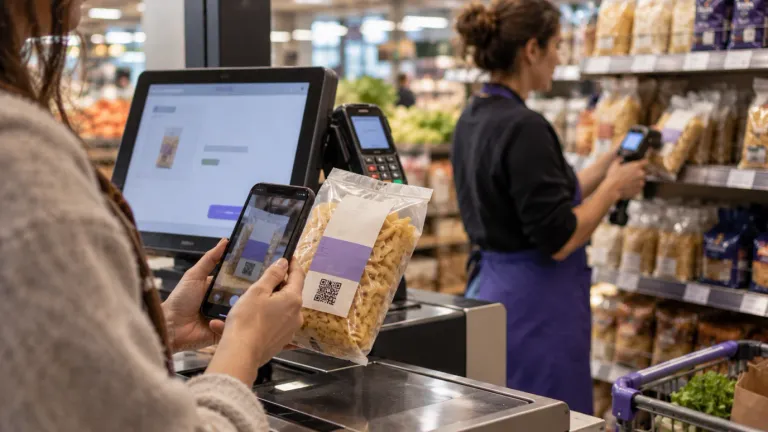
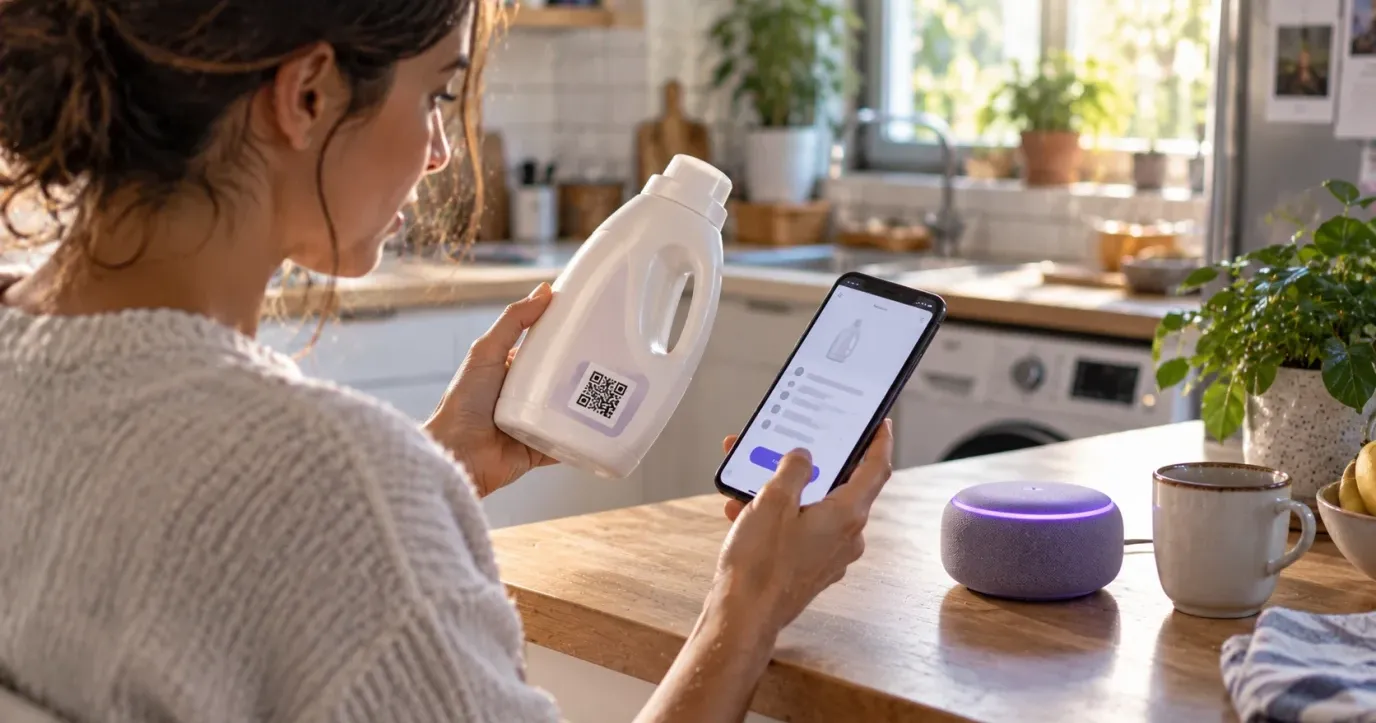
A QR code helps here because it carries that identity on the physical product, so a person, a phone or an agent looking at a photo of the pack can reach the same source. It does not help if the URI behind it leads to a marketing page with no structured data, or if the identifier never appears in the feeds and pages the agent actually reads.
Trust and authenticity
Agents remove the moment when a person looks at a listing and thinks "that seems off", so counterfeits and mismatched listings are harder to catch. An agent needs a way to check that a listing refers to the brand's real product, and, after delivery, that the item in hand is genuine. Signed credentials of the kind AP2 uses for payment intent point at how this could work for products too. We look at the options in how an agent verifies a product is genuine.
Payments and checkout
This is the most standardised part, and for most brands the least work. Your commerce platform and payment provider are the ones that would support ACP, AP2 or UCP. The decision a brand faces is which channels to enable. What the brand still controls is the product reference that flows into the cart and the mandate, and whether it is exact.
Regulation
We found no EU rules written specifically for purchases made by AI agents, so existing rules apply, and some of them assume a person at a screen. Three are directly relevant.
- Consumer law. Under the Consumer Rights Directive 2011/83/EU, the trader must give the consumer the main characteristics of the goods before a distance contract binds them (Article 6(1)(a)), must make sure the consumer explicitly acknowledges that an online order implies an obligation to pay (Article 8(2)), and the consumer has 14 days to withdraw from a distance contract (Article 9(1)). How these apply when an agent places the order is still being worked out; our reading is that every one of them is easier to honour when the order names an exact product.
- The AI Act. Under Article 50(1) of Regulation (EU) 2024/1689, providers of AI systems intended to interact directly with people must design them so that people are informed they are interacting with an AI system, unless that is obvious. This has applied since 2 August 2026, and the Digital Omnibus on AI, Regulation (EU) 2026/1744, did not change that date. The obligation falls on the provider of the AI system, which for most brands is the AI platform.
- The Digital Product Passport. Under the ESPR, Regulation (EU) 2024/1781, a passport must be connected through a data carrier to a persistent unique product identifier, and its data must be based on open standards and, as appropriate, machine-readable and structured. The ESPR was not written for agents, but it requires exactly the kind of product data agents need. We cover the link in the machine-readable DPP.
What your product needs: the checklist
| Need | Why an agent needs it | What good looks like |
|---|---|---|
| A persistent identifier | To know which exact product it is acting on | GTIN assigned for every variant and pack size, never reused |
| A Web identity for that identifier | To resolve the product to its source of truth | A GS1 Digital Link URI on a domain the brand controls |
| The identifier everywhere | So every offer and listing points to the same item | GTIN in feeds, schema.org markup, marketplace listings and on pack |
| Structured attributes | To compare and evaluate without guessing | Specifications, ingredients, dimensions, compatibility as data, not images |
| Claims with evidence | To trust what the product page says | Each claim linked to its certificate, method or test |
| Proof of authenticity | To avoid counterfeits and mismatched offers | A verifiable link between the item and the brand's own record |
| Machine-readable passport data | For regulated product groups, and as a data source | DPP data in structured form, reachable from the data carrier |
| An agent-accessible source | So agents can ask the brand, not only the retailer | Product data exposed through a resolver, an API or an MCP server |
What to do now
- Check your identifiers. Confirm that every variant, size and pack has its own GTIN, and that discontinued GTINs are not being reused for new products.
- Put the GTIN everywhere the product is described. Your own product pages, your structured data, every feed you send to retailers and AI platforms, and every marketplace listing. Fill in the optional identifier fields.
- Give each product a Web identity. Encode a GS1 Digital Link URI on the pack and make it resolve to a page the brand controls, with structured data on it.
- Turn your product information into data. Move key attributes out of images and PDFs into structured fields, and link each claim to its evidence.
- Ask your commerce and payment providers about agent checkout. Find out which protocols they support or plan to support, and which AI channels you can enable without custom work.
- Connect your DPP plans to your agent plans. If your product group falls under the ESPR, the passport data you will have to publish is the same structured data agents need. Build it once.
- Run an agent test. Ask several AI assistants to find and compare your product against its nearest variant, and see whether they get the noun right.
Digital Link is a GS1 solution partner, and our platform gives each product a standards-based GS1 Digital Link identity, with a QR code on pack and a page behind it that carries structured, machine-readable product data and can be updated without reprinting. For agentic commerce, that means one brand-controlled source of truth that any agent can resolve, whichever protocol it uses to check out. If you want to see how your products look to an AI agent today, get in touch and we will review them with you.
Frequently asked questions
Is agentic commerce already happening?
Yes, in early form. Open protocols for agent checkout and payment authorisation have been published since September 2025, and AI platforms and payment providers have started connecting merchants to them. As of October 2026, ACP describes its specification as beta and AP2 is at version 0.2.
What is the difference between ACP, AP2 and MCP?
MCP is a general standard for connecting AI applications to external data and tools. ACP, developed by Stripe and OpenAI, defines how an agent runs a checkout and passes a payment credential to a merchant. AP2, announced by Google and now being donated to the FIDO Alliance, defines signed mandates that prove what a user authorised.
Do agent protocols require a GTIN or GS1 Digital Link?
No. None of the protocol specifications we reviewed makes a GTIN or GS1 Digital Link mandatory, and OpenAI's product feed specification lists the GTIN as optional. Our view is that supplying it anyway is the most reliable way to make sure an agent buys the exact product the person meant.
Who is responsible if an AI agent buys the wrong product?
We found no EU rules written specifically for agent purchases as of October 2026, so existing consumer law applies, including the 14-day right of withdrawal for distance contracts. Protocols such as AP2 aim to create an audit trail of what the user authorised. A purchase that names an exact product identifier makes every one of those questions easier to answer.
Does the EU AI Act apply to my brand if agents buy my products?
Generally not because of that alone. The transparency duty in Article 50(1), applicable since 2 August 2026, falls on providers of AI systems that interact directly with people. If your brand deploys its own shopping assistant, check your position under the Act.
How does the Digital Product Passport relate to agentic commerce?
The ESPR requires passport data to be linked to a persistent product identifier through a data carrier and to be structured and, as appropriate, machine-readable. That is exactly the kind of data agents need. A brand that builds its passport on an open identifier like GS1 Digital Link prepares for both at once.