
TL;DR
- The EU rules on green claims, set by Directive (EU) 2024/825, have applied across the EU since 27 September 2026. There is no transition period for products already on the shelf.
- The Directive bans, in all circumstances, generic claims such as "eco-friendly" without recognised excellent environmental performance, self-made sustainability labels, and "climate neutral" claims based on offsetting.
- A QR code cannot turn a vague claim into a specific one: the specification has to sit on the same medium as the claim. Where the QR code is the right tool is the evidence behind the claim, and for future-performance claims the Commission names it explicitly.
Directive (EU) 2024/825, the Empowering Consumers for the Green Transition Directive, is the EU law on green claims that applies today. It amends two existing consumer laws, the Unfair Commercial Practices Directive 2005/29/EC and the Consumer Rights Directive 2011/83/EU. It does not create a new labelling regime. It changes what counts as an unfair commercial practice, and the most visible place that bites is the front of the pack.
This guide covers what the Directive bans, what the "same medium" rule means for packaging with limited space, and the specific situations where a QR code linking to evidence is exactly what the rules ask for. Everything below is stated as of October 2026.
When did the rules start to apply?
The Directive was signed on 28 February 2024 and entered into force on 26 March 2024. Member States had until 27 March 2026 to adopt national measures and have had to apply them from 27 September 2026.
| Date | What happens |
|---|---|
| 28 February 2024 | Directive signed in Strasbourg |
| 6 March 2024 | Published in the Official Journal |
| 26 March 2024 | Entry into force |
| 25 September 2025 | Implementing Regulation (EU) 2025/1960 sets the harmonised guarantee notice and durability label |
| 27 March 2026 | Deadline for Member States to adopt and publish national measures |
| 27 September 2026 | National rules apply, together with Implementing Regulation (EU) 2025/1960 |
| 27 September 2031 | Commission report on how the Directive is working |
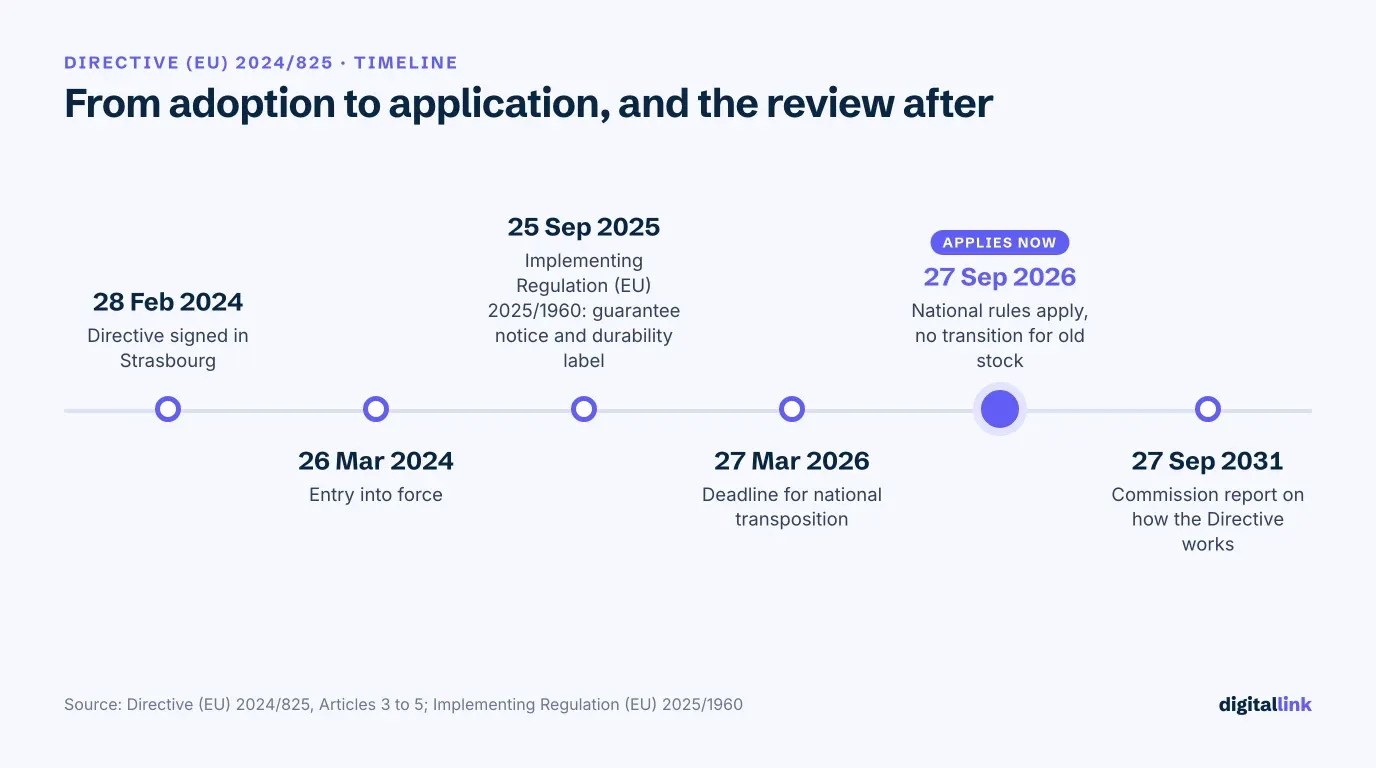
Because this is a directive, the rule that binds a brand is the national law that transposes it, and enforcement sits with national consumer authorities and courts. Transposition has not been uniform, so for any given market it is worth confirming the national text. The substance, however, is set by the Directive and is the same everywhere.
There is no grace period for old stock. The Commission's Questions and Answers, published in September 2026, are explicit that claims on packaging already manufactured, distributed or on shelves before the application date must also comply. The practical options it names are covering or correcting claims with stickers, or adding supplementary information at the point of sale. National consumer authorities in the CPC Network have agreed a common understanding on old stock, and enforcers may weigh whether a trader made reasonable and proportionate efforts.
What is an environmental claim under the Directive?
An environmental claim is any voluntary message, in any form, that states or implies a product, brand or trader has a positive or zero impact on the environment, is less damaging than others, or has improved over time. Text, logos, labels, brand names, company names and product names all count.
Two details in that definition matter for packaging.
First, the word voluntary. A message that Union or national law makes mandatory is not an environmental claim. The sorting instructions, material codes and, in time, the digital product passport data a product is obliged to carry are not marketing, and this Directive does not treat them as such.
Second, implied claims count. Green leaves, water drops and green backgrounds on their own are not a generic claim, but combined with written text they can be, and the Commission's Q&A warns packaging designers about exactly that combination.
The Directive applies to business-to-consumer communication only. B2B marketing and mandatory sustainability reporting under the CSRD fall outside it, unless the content of a sustainability report is reused in consumer advertising.
What is now banned on the pack?
The Directive adds new entries to Annex I of the Unfair Commercial Practices Directive, the blacklist of practices prohibited in all circumstances. For these, an authority does not have to prove that consumers were actually misled.
| Annex I point | What is prohibited | Example on a pack |
|---|---|---|
| 2a | Displaying a sustainability label not based on a certification scheme or established by a public authority | An in-house "Planet Promise" leaf logo |
| 4a | A generic environmental claim without recognised excellent environmental performance relevant to the claim | "Eco-friendly packaging" |
| 4b | A claim about the whole product or the whole business when it concerns only one aspect | "Sustainable bottle" when only the cap is recycled content |
| 4c | Claiming a neutral, reduced or positive greenhouse gas impact on the basis of offsetting | "Climate neutral" backed by carbon credits |
| 10a | Presenting a legal requirement for the whole category as a distinctive feature | "Now compliant with the EU packaging rules" as a selling point |
| 23g | Falsely claiming a durability in usage time or intensity under normal use | "Lasts 10,000 washes" without basis |
| 23h | Presenting a good as repairable when it is not | A repair icon on a sealed device |
Alongside the blacklist, two practices are now misleading after a case-by-case assessment under Article 6(2): future-performance claims without a verified implementation plan, and advertising irrelevant benefits, such as "plastic-free" on paper sheets, which never contain plastic. The other new blacklist points, 23d to 23j, deal with software updates, consumables and early obsolescence.
What counts as recognised excellent environmental performance?
Three routes, and only three. Compliance with the EU Ecolabel, Regulation (EC) No 66/2010; compliance with an officially recognised national or regional EN ISO 14024 type I ecolabel; or top performance under other Union law, such as energy label class A. The performance must also be relevant to the whole claim: an EU Ecolabel whose criteria say nothing about biodegradability does not support the word "biodegradable".
What makes a sustainability label lawful?
It must be established by a public authority, which the Commission reads as an EU public authority, or be based on a certification scheme that meets four conditions: it is open to all traders on fair terms, its requirements are developed with experts and stakeholders, it has procedures to suspend or withdraw the label for non-compliance, and compliance is monitored by a third party independent of both the scheme owner and the trader. The Commission's Q&A adds that the scheme owner and the monitoring body must be two separate legal entities.
Can a QR code turn a generic claim into a specific one?
No, and this is the point most worth getting right.
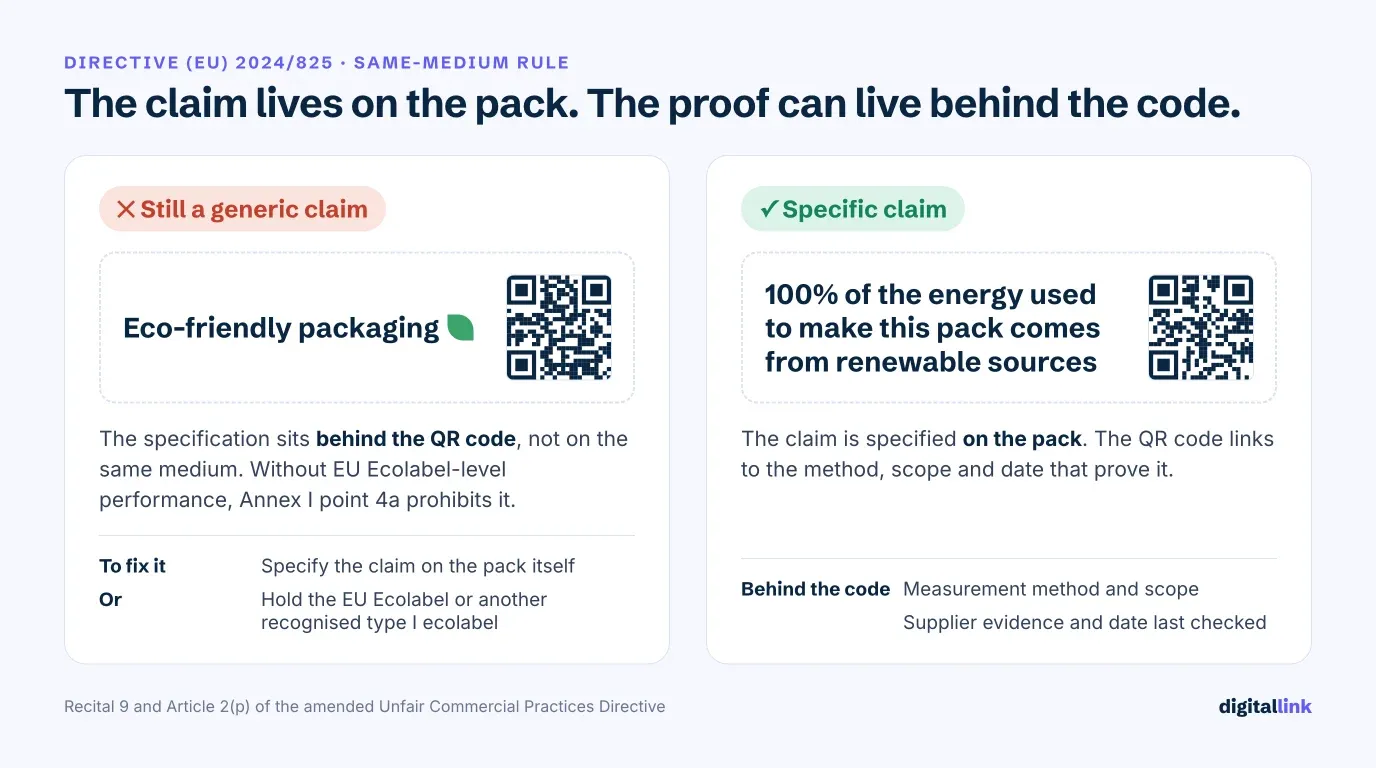
A claim stops being generic when its specification is given in clear and prominent terms on the same medium. Recital 9 names the product's packaging as an example of that medium. The Commission's Q&A goes further: the specification should sit next to, or be part of, the claim, and it repeats the existing guidance that where there is no room to specify a claim on the pack, the claim should generally not be made.
So "eco-friendly packaging" with a QR code underneath leading to a page of explanations is still a generic claim on the pack, and without EU Ecolabel-level performance it is still prohibited. Writing "100% of the energy used to make this packaging comes from renewable sources" on the pack itself is a specific claim. That claim then has to be true, accurate and provable, but it is no longer blacklisted for being vague.
The honest summary for a packaging team: the claim lives on the pack, the proof can live behind the code.
Where a QR code is the right tool
Once the claim is specific and on the pack, the Directive creates several places where linked evidence is not a workaround but the expected answer.
Future-performance claims: the Commission names the QR code
A claim such as "net zero by 2035" or "100% recycled packaging by 2028" is only fair under Article 6(2)(d) if it is backed by clear, public and verifiable commitments in a detailed and realistic implementation plan, with measurable, time-bound targets and allocated resources, regularly verified by an independent third-party expert whose findings are made available to consumers.
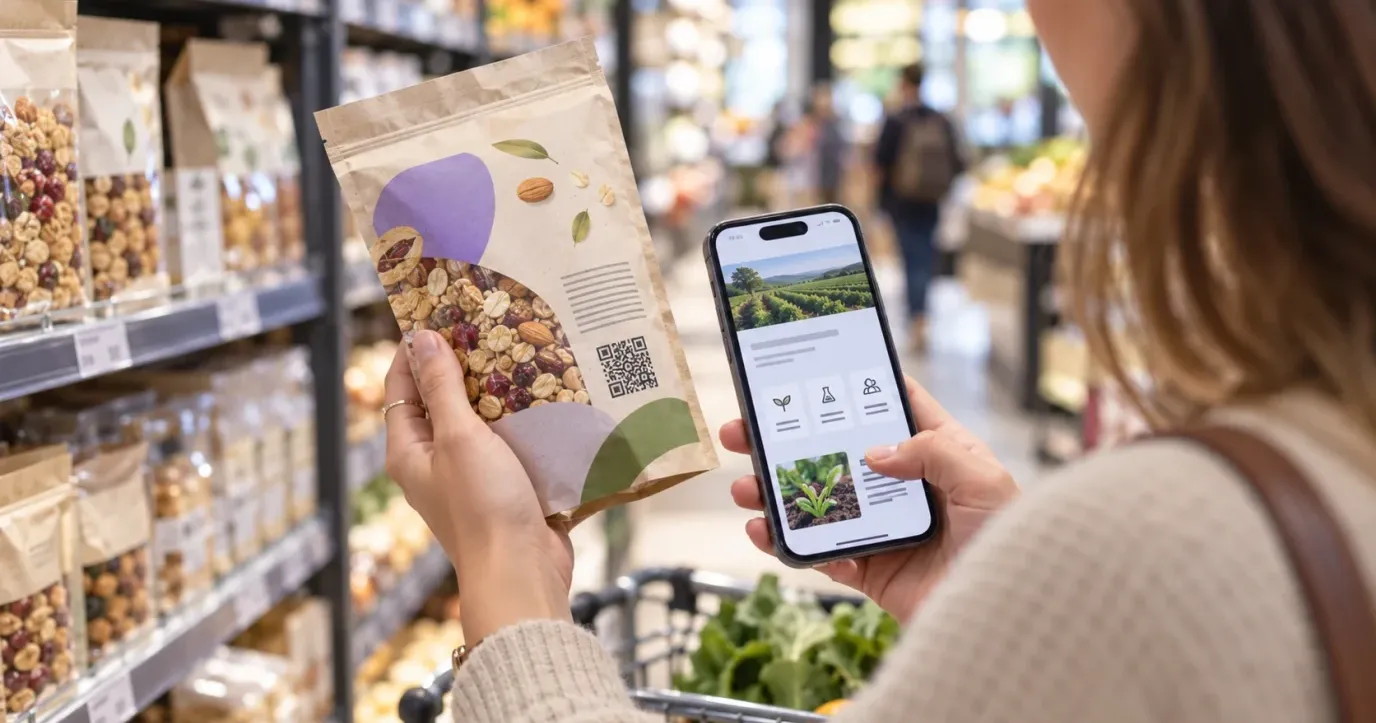
The Directive does not say how. The Commission's September 2026 Q&A does: the implementation plan does not have to be on the same medium as the claim, and both the plan and the expert's findings can be reached through a QR code on the packaging that leads to the trader's website. It is the clearest statement in the official guidance that a data carrier is a compliant route, and it fits this case precisely, because the plan and the verification reports change over time while the pack does not.
The evidence behind a specific claim
A specific claim such as "50% recycled content" escapes the blacklist but remains subject to the general rules against misleading actions and omissions. In practice, that means the brand has to be able to back it up. Linking from the pack to the measurement method, the scope of the figure and the date it was last checked is not a legal formality, but it is the most direct way to show that the claim was made in good faith, and it is the information an enforcer will ask for first.
Sustainability labels and their scheme
A label is only lawful if its certification scheme's terms are publicly available, and the trader is expected to check them before displaying it. A code that resolves to the scheme, the certificate number and its validity turns that obligation into something a consumer, a retailer or an inspector can verify in one scan.
Comparison tools
Under the new Article 7(7) of the Unfair Commercial Practices Directive, a trader that compares products on environmental or social characteristics, durability, reparability or recyclability must disclose the method of comparison, the products and suppliers compared and how the information is kept up to date. Omitting it can be a misleading omission.
What should not move behind a code
The harmonised notice on the legal guarantee and the harmonised label for a commercial guarantee of durability, whose design is fixed by Implementing Regulation (EU) 2025/1960, are meant to be seen at the point of sale: on the packaging, on the shelf or next to the product picture online. They are not candidates for a QR code.
Is this the Green Claims Directive?
No. The Green Claims Directive was a separate Commission proposal, COM(2023) 166, which would have required claims to be substantiated and verified before use. In June 2025 the Commission announced its intention to withdraw it, and the final trilogue was cancelled. As of October 2026 it has not been adopted.
Directive 2024/825 is the law that applies. It does not impose prior verification of every claim, but it bans the vaguest categories outright and leaves the rest to the existing test of whether a claim misleads.
How this sits with PPWR and the Digital Product Passport
The Unfair Commercial Practices Directive is the general safety net. Where sector-specific EU law regulates a matter, that law takes precedence, and mandatory information is outside the definition of an environmental claim in the first place.
Two consequences for brands preparing for the Packaging and Packaging Waste Regulation and the ESPR:
- The recyclability grades, material information and Digital Product Passport data those laws require are not voluntary claims, and they are not caught by this Directive's bans.
- Presenting that compliance as a selling point is. Under Annex I point 10a, "meets the new EU packaging rules" is prohibited when every competing product in the category has to meet them too.
The data carrier is where the two meet. The same GS1 Digital Link QR code that will carry mandatory passport data can, today, link to the evidence behind a brand's voluntary claims, kept separate on the page from what is legally required.
What packaging teams should do now
The Directive already applies, so this is a compliance review, not a preparation plan.
- Inventory every claim and label on pack and online, including brand and product names with an environmental connotation, and imagery combined with text.
- Remove or rewrite generic claims unless you hold the EU Ecolabel, a recognised type I ecolabel or top-class performance under Union law relevant to the whole claim. Replace "eco-friendly" with what is actually true and measurable.
- Drop every offset-based product claim. "Climate neutral", "CO2 compensated" and similar are prohibited in all circumstances when they rest on offsetting. Communicating your investment in carbon projects separately and transparently remains possible.
- Check every sustainability label against the certification-scheme criteria. In-house logos and labels from non-EU public authorities without a certification scheme have to go.
- For future-performance claims, build the implementation plan and appoint the independent expert before the claim is made, and put both behind a QR code on the pack.
- Plan the old stock. Stickers or point-of-sale information for packaging already in the channel, and a documented record of the effort.
- Keep the evidence linkable. For each specific claim, one page with the method, the scope, the figure and the date, reachable from the pack.
Digital Link is a GS1 solution partner, and our platform puts a standards-based GS1 Digital Link QR code on each product with a page behind it that can be updated without reprinting packaging. For green claims, that matters most for future-performance commitments, whose implementation plan and verification reports change every year while the printed pack stays the same. If you want to review your claims against the new rules, get in touch and our legal team will look at your case.
Frequently asked questions
When does Directive (EU) 2024/825 apply?
From 27 September 2026, through each Member State's transposing law. Member States had to adopt their national measures by 27 March 2026. There is no transition period for products already on the market.
Is "eco-friendly" banned on packaging?
As a generic claim, yes, unless the trader can demonstrate recognised excellent environmental performance relevant to the claim: the EU Ecolabel, an officially recognised EN ISO 14024 type I ecolabel, or top performance under other Union law. A claim specified clearly on the pack itself is no longer generic.
Can I put the explanation of my claim behind a QR code?
Not to make a generic claim lawful. The specification has to be on the same medium as the claim, which for a product means the packaging. A QR code is appropriate for the evidence behind a specific claim, and the Commission's Q&A explicitly accepts it for the implementation plan and third-party findings behind future-performance claims.
Can I still say a product is carbon neutral?
Not on the basis of offsetting. Annex I point 4c prohibits claims of neutral, reduced or positive greenhouse gas impact based on offsetting in all circumstances. Claims based on real reductions across the product's own life cycle remain possible if specified on the same medium and substantiated.
Can I keep using my own sustainability logo?
Only if it is based on a certification scheme that is open to all traders, developed with stakeholders, able to withdraw the label and monitored by an independent third party, or established by an EU public authority. A logo the brand created for itself without such a scheme is prohibited.
Does the Directive apply to B2B communication?
No. It covers business-to-consumer commercial practices only. Member States may extend protection to businesses in national law, and B2B advertising remains subject to the Misleading and Comparative Advertising Directive.
Is the Green Claims Directive in force?
No. The proposal stalled in June 2025, when the Commission announced its intention to withdraw it, and as of October 2026 it has not been adopted. Directive 2024/825 is the green claims law that applies.