

TL;DR
- The EU Digital Product Passport is a digital record of a product's identity, composition, environmental performance and end-of-life information, reached through a data carrier such as a QR code on the product, its packaging or its documents.
- It is created by Regulation (EU) 2024/1781 (the ESPR), but the obligation arrives product group by product group. Batteries come first, from 18 February 2027, under their own regulation. Textiles, furniture, tyres, mattresses, steel and aluminium are next in line, with their delegated acts still pending.
- The passport is hosted by the company, not by the EU. What every product group will share is a persistent unique identifier on the product and a carrier that resolves to the passport, which is why identifier and carrier work done now is not wasted.
The EU Digital Product Passport (DPP) is a structured, machine-readable record of a product's key information, such as what it is made of, where it comes from, how to repair it and how to recycle it. It is linked to the physical product through a data carrier, usually a QR code, that points to a persistent unique identifier. Scan the code and you reach the passport, with each reader (a shopper, a repairer, a recycler or an authority) seeing the information meant for them.
The passport is the centrepiece of the Ecodesign for Sustainable Products Regulation, Regulation (EU) 2024/1781, which entered into force on 18 July 2024. The Regulation sets the rules every passport must follow. It does not, by itself, require your product to carry one: that happens when a delegated act covers your product group.
The Digital Product Passport at a glance
| What it is | A digital record of product information, linked to the item through a data carrier |
| Legal basis | Regulation (EU) 2024/1781 (ESPR), Chapter III, Articles 9 to 15; batteries under Regulation (EU) 2023/1542 |
| Who must provide it | The manufacturer, or whoever places the product on the EU market under its own name |
| Where it lives | On systems chosen by the company; the EU registry stores the identifiers, not the passports |
| How it is reached | A data carrier, such as a QR code, on the product, its packaging or its documentation |
| When it applies | From the date in the delegated act for each product group; batteries from 18 February 2027 |
What every passport must do
Article 10 of the ESPR sets the essential requirements that apply to every passport, whatever the product group. A passport must:
- be connected through a data carrier to a persistent unique product identifier
- have that carrier physically present on the product, its packaging or its accompanying documentation, as the delegated act specifies
- use a carrier and identifier that comply with recognised standards, now the harmonised CEN and CENELEC DPP standards
- hold its data on open standards, in a format that is interoperable, machine-readable, structured, searchable and transferable without vendor lock-in
- refer to the product model, the batch or the individual item, at the level the delegated act sets
- give different readers different access: the public, operators with a legitimate interest, and authorities
The passport stays with the company. The Commission runs a central DPP registry that stores the unique identifiers and links, and a public web portal for searching passport data, but it does not host the passports themselves.
What goes into a passport
The exact list is set for each product group by its delegated act, drawing on Annex III of the ESPR. Across product groups, the information falls into a few recurring families:
| Information | Examples | Usually visible to |
|---|---|---|
| Identity | Unique product identifier, model, batch, manufacturer, importer | Everyone |
| Composition | Materials, substances of concern, recycled content | Everyone, or operators for detail |
| Environmental performance | Carbon footprint, durability, energy use | Everyone |
| Use and repair | Instructions, spare parts, repairability information | Everyone, repairers for detail |
| End of life | Disassembly, sorting and recycling instructions | Recyclers and treatment operators |
| Compliance | Declaration of conformity, certificates, technical documentation | Authorities |
The battery passport is the first full example: Annex XIII of the Battery Regulation splits its data between what the public sees and what is reserved for authorities and operators with a legitimate interest.
Which products need one, and when
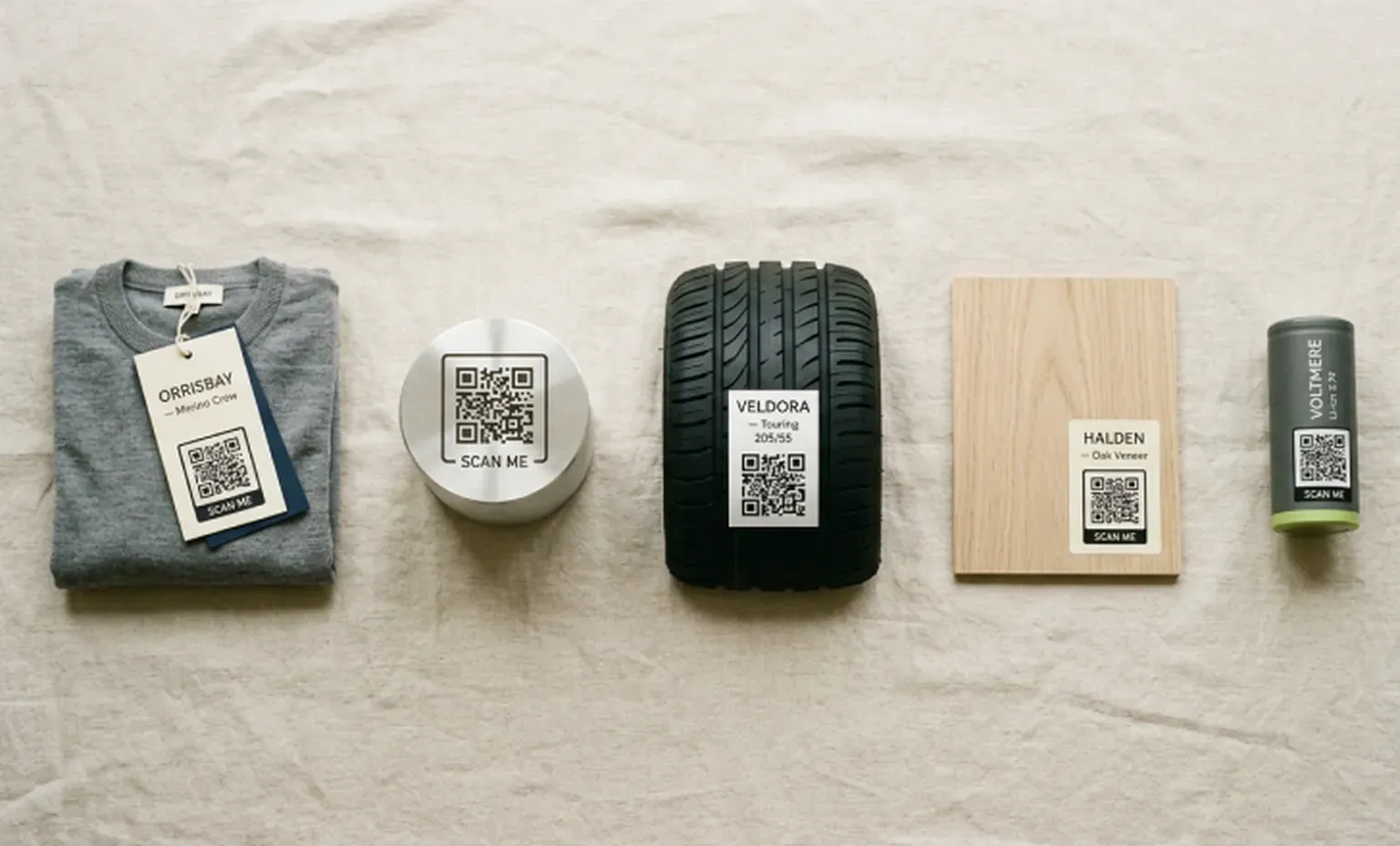
The obligation arrives sector by sector. As of October 2026:
| Product group | Instrument | Status |
|---|---|---|
| Batteries: LMT, EV and industrial over 2 kWh | Regulation (EU) 2023/1542, Article 77 | Passport required from 18 February 2027 |
| Construction products | Regulation (EU) 2024/3110 | Applies since 8 January 2026; its passport follows its own delegated acts |
| Detergents | Regulation (EU) 2026/405 | Passport included; applies from 23 September 2029 |
| Textiles and apparel | ESPR delegated act | Prioritised in the 2025–2030 working plan; act pending |
| Furniture, mattresses, tyres | ESPR delegated acts | Prioritised in the 2025–2030 working plan; acts pending |
| Iron, steel and aluminium | ESPR delegated acts | Prioritised as intermediate products; acts pending |
| Electrical and electronic equipment | ESPR horizontal measures | Repairability score and recyclability requirements announced |
Everything else follows in later working plans. The ESPR covers almost any physical good placed on the EU market, with a short list of exclusions such as food, feed, medicines, living plants and animals. A product made outside the EU is covered in the same way as one made inside it: the importer has to check the passport is there before placing it on the market.
Who is responsible for what
The duties are spread along the supply chain, not loaded onto the manufacturer alone:
| Who | What they must do |
|---|---|
| Manufacturer | Create the passport and keep it accurate and available |
| Importer | Check that the product conforms and carries its passport before placing it on the market |
| Distributor | Check that the required passport and labels are present |
| Dealer, including online | Make the passport accessible to customers, also before the sale in distance selling |
| Online marketplace | Cooperate with authorities on compliance and traceability |
| Supply chain actors | Give the manufacturer the information it needs |
An importer or retailer that sells a product under its own name or trademark takes on the manufacturer's duties. The ESPR guide lists the articles behind each row.
How the code on the pack connects to the passport

For most consumer-facing goods, the data carrier will be a 2D code on the pack that resolves to a web address. The Regulation names no single technology: each delegated act chooses the carrier for its product group.
GS1 Digital Link is the widely used standard for exactly this job. It writes a product's GTIN, and optionally its batch or serial number, into a web address, so one QR code:
- carries a persistent unique identifier built on the GTIN the product already has
- works at the model, batch or item level, by adding a batch or serial number to the URL
- routes each reader to the right layer through a resolver: the public page for shoppers, detailed data for repairers and recyclers, compliance documents for authorities
- still rings up at a 2D-ready checkout, so the passport does not need a separate code next to the barcode
Open standards also keep the cost down. A 2022 Deloitte study estimated the cost of a DPP system built on global open standards at EUR 3 to 7 billion, against EUR 63 to 152 billion for competing proprietary systems. For one company's budget, see how much a Digital Product Passport costs.
How to prepare now
- Find your product group's instrument. Check the table above. If you make batteries, your date is fixed. If not, follow the delegated act for your group, which sets your real deadline and your data list.
- Get persistent identifiers in place. Every passport needs one. If your products carry an EAN or UPC barcode, you already have GTINs from your GS1 Member Organization.
- Decide the level. Model level is the simplest. Batch and item level take more data and usually variable-data printing, so plan them with your printer.
- Map your data. Most of the work is gathering and verifying information you already hold across suppliers and systems, not the technology.
- Put the carrier on the pack at the next artwork change. A web-resolvable code printed now can point at a simple product page today and at the full passport when your act applies, without reprinting. How to create a Digital Product Passport walks through the build.
Where the Digital Link platform fits
Digital Link, the platform behind this site, is software for creating and hosting passports. It is not the EU's system or GS1. It generates conformant QR codes from your GTINs, runs the resolver that routes each reader to the right information, and hosts the passport pages, with access levels for the public, operators and authorities. The Free plan covers 5 codes.
Create your first Digital Product Passport
Frequently asked questions
Is the Digital Product Passport mandatory today?
Not for most products. The ESPR creates the passport, but the obligation arrives through a delegated act for each product group. Batteries are the first hard date, from 18 February 2027, under Regulation (EU) 2023/1542.
When will textiles need a Digital Product Passport?
Textiles, with a focus on apparel, are prioritised in the 2025–2030 working plan, but the delegated act that sets the date and the data list has not been adopted yet. The passport will apply from the date in that act.
Does a Digital Product Passport have to be a QR code?
No. The Regulation requires a data carrier connected to a persistent unique identifier, and each delegated act chooses the carrier. For consumer goods that will usually be a QR code, but a Data Matrix or an RFID tag can also qualify.
Who hosts the Digital Product Passport?
The company that places the product on the market, or a service provider acting for it. The EU registry stores the unique identifiers and links, not the passport data.
Do companies outside the EU need a Digital Product Passport?
Yes, if their products are sold in the EU and their product group is covered. The importer must check that the passport is there before placing the product on the market.
Is the battery passport a Digital Product Passport?
Yes, in substance. It comes from the Battery Regulation rather than the ESPR, but it follows the same idea and its identifiers go into the same EU registry. It is the first passport with a fixed date.