

TL;DR
- CLP digital labelling has been allowed since 1 July 2026: a QR code can link to a digital label, but the printed hazard label stays, and today supplemental information is the only element allowed online alone.
- Omnibus VI, adopted by the European Parliament on 22 October 2026 and still awaiting the Council, widens what may move online and requires a "digital contact" on every hazard label.
- Hazard pictograms stay printed, cosmetics get no digital label, and fertilisers put their declaration of conformity behind the same data carrier as their digital label. The digital changes apply 30 to 36 months after the act enters into force.
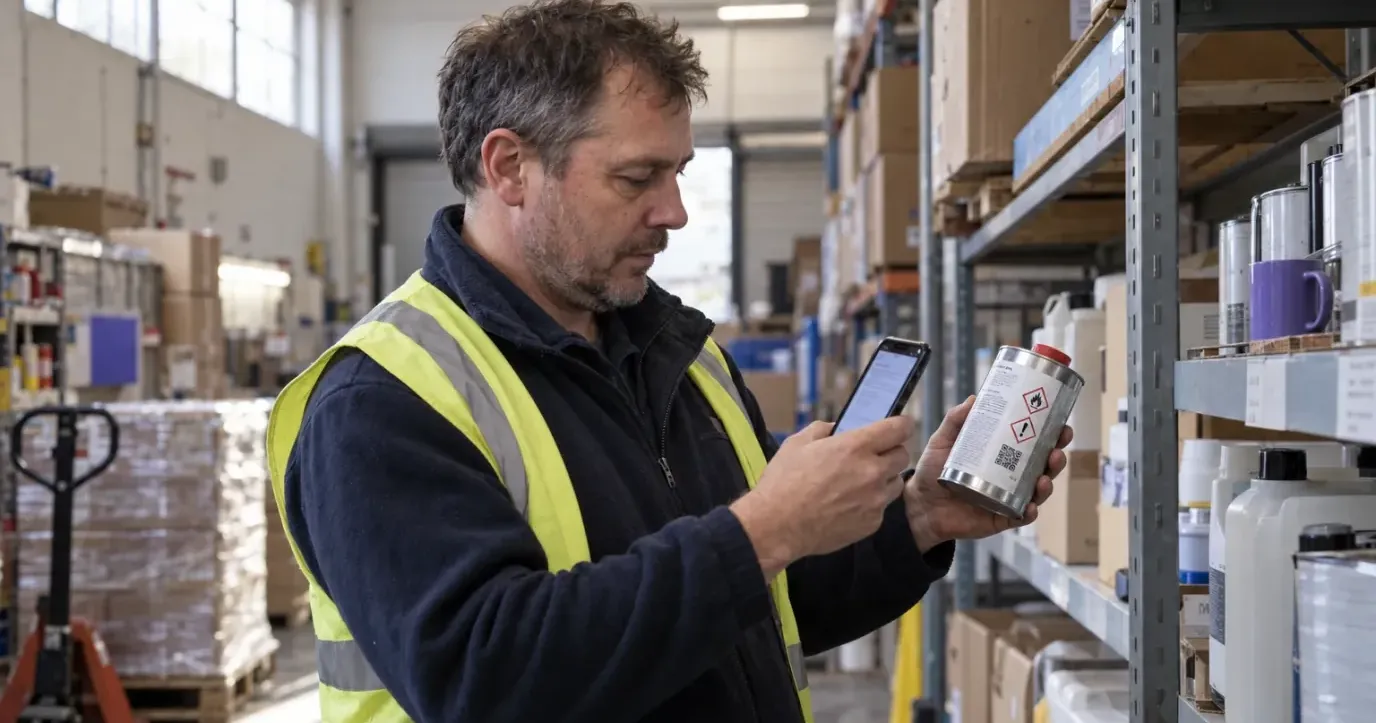
CLP digital labelling lets suppliers of hazardous substances and mixtures provide the label elements required by the CLP Regulation, Regulation (EC) No 1272/2008, on a digital label reached through a data carrier such as a QR code. The option was created by the 2024 revision of CLP, Regulation (EU) 2024/2865, and has applied since 1 July 2026. The EU's chemicals simplification package, known as Omnibus VI, now extends it, in line with what the text describes as the Commission's "digital by default" principle.
This guide covers what the digital label allows today, what Omnibus VI changes once it is in force, what must stay on the physical label, how cosmetics and fertilisers are affected, and where a QR code genuinely helps. Omnibus VI is not law yet. Parliament has adopted the agreed text, the Council still has to adopt it, and nothing in it applies before it is published in the Official Journal. Everything below is stated as of October 2026.
The dates that matter
| Date | What happens |
|---|---|
| 20 November 2024 | Regulation (EU) 2024/2865 revising CLP is published; it enters into force on 10 December 2024 |
| 8 July 2025 | The Commission proposes Omnibus VI, COM(2025) 531, amending the CLP, Cosmetics and Fertilising Products Regulations |
| 3 December 2025 | Regulation (EU) 2025/2439 moves the 2024 rules on label formatting, relabelling, advertising, distance sales and fuel pumps to 1 January 2028 |
| 17 June 2026 | Parliament and Council negotiators reach a provisional agreement on Omnibus VI |
| 1 July 2026 | The CLP digital label (Articles 34a and 34b) and the data carrier rule (Article 31(1b)) apply |
| 22 October 2026 | Parliament adopts the agreed Omnibus VI text at first reading |
| 1 May 2027 | Digital labels for EU fertilising products apply, under Regulation (EU) 2024/2516 |
| After Council adoption | Omnibus VI is published and enters into force 20 days later |
| Entry into force + 18 months | New CLP formatting rules, a 15-month relabelling deadline, and the advertising and distance sales rules |
| Entry into force + 30 months | Fertilisers: digital contact and electronic declaration of conformity |
| Entry into force + 36 months | CLP: digital contact on the label and a wider list of digital-only label elements |
Omnibus VI also replaces the 1 January 2028 date set by Regulation (EU) 2025/2439. Formatting, relabelling, advertising and distance sales would instead apply 18 months after Omnibus VI enters into force. Until then, 1 January 2028 remains the date in the Official Journal.
What is a CLP digital label today?
Article 34a sets the principle. The label elements listed in Article 17 are provided on a label in physical form, and in addition they may be provided in digital form. The physical label is the rule and the digital label is an option. Section 1.6 of Annex I lists the elements that may appear on the digital label only, and today that list has a single entry: supplemental information under Article 25(3).
Where elements are provided digitally only, the supplier must also provide them by other means on oral or written request, or when the digital label is temporarily unavailable at the time of purchase. That service has to be free of charge and independent of a purchase.
The link between the two labels is set by Article 31(1b). A data carrier linking to the digital label must be firmly affixed or printed on the physical label, or on the packaging next to it, so that widely used digital devices can process it automatically. Where some elements are digital only, the carrier must be accompanied by the statement "More hazard information available online" or a similar indication.
Article 34b then sets the rules for the digital label itself:
| Requirement in Article 34b | What it means in practice |
|---|---|
| All Article 17(1) label elements together in one place, separate from other information | A dedicated label section, not hazard text scattered across a product page |
| Searchable information | Real text, not only a picture of the label |
| Accessible to all users in the Union for at least 10 years | The link has to outlive the product range and any campaign |
| Free of charge, with no registration, app or password | It opens in an ordinary browser from a phone camera |
| Presented with the needs of vulnerable groups in mind | Readable, accessible design |
| No more than two clicks to the information | The hazard information cannot sit deep inside a website |
| Works on widely used technologies, all major operating systems and browsers | No proprietary reader |
| Language choice not tied to the user's location | Users can switch language wherever they are |
| No tracking, analysis or use of usage information beyond what is absolutely necessary | No marketing analytics on the digital label |
The last row matters to anyone who already uses QR codes for marketing, and we come back to it below.
What does Omnibus VI change for the digital label?
The agreed text, as adopted by Parliament (P10_TA(2026)0362), rewrites section 1.6 of Annex I and adds a new label element.
| Label element | CLP today | After Omnibus VI |
|---|---|---|
| Supplemental information (Article 25(3)) | May be digital only | May be digital only |
| Name, address and digital contact of additional suppliers | Physical label | May be digital only, as long as the supplier referred to in Article 4(11) appears on the physical label |
| Telephone number of the suppliers | Physical label | May be digital only, or reached through the digital contact |
| Everything except the hazard pictograms on technically constrained inner packaging | Physical label | May be digital only, with a data carrier on both the inner and the outer packaging |
| Digital contact of the suppliers | Not required | Required on the label |
The digital contact
Omnibus VI adds a "digital contact" to the supplier details in Article 17(1)(a), next to name and address. The new definition is an online communication channel that is up to date and free of charge, such as an email address, through which the supplier can be contacted without registering or downloading a supplier-specific app.
The recitals give examples: an email address, a contact form on a website, or any other direct means of digital communication that keeps a trace of the exchange. Automatic replies, chatbots, fax numbers and automated telephone lines do not count. The telephone number stays a label element, but it may be left off the physical label if it is directly available through the digital contact, for example stated clearly on the contact web page or sent in an email auto-response.
The digital contact sits on the physical label like the supplier's address. Print it as text a person can read and type, such as an email address or a short web address: the text does not say that a QR code alone is enough.
Small inner packaging
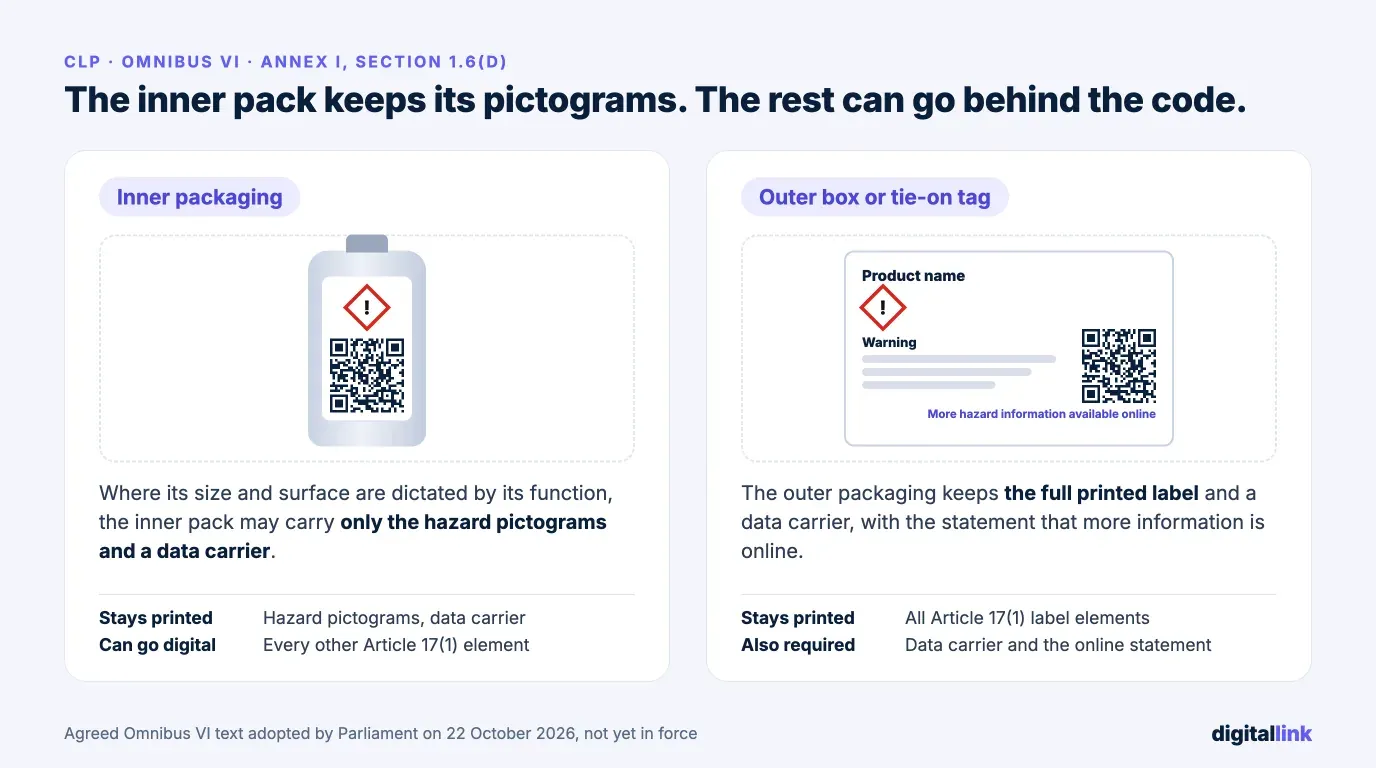
The most practical change is point (d) of the new section 1.6. Where a product has both outer and inner packaging, and the size and surface of the inner packaging are constrained by the technical requirements of its intended function, every label element on the inner packaging except the hazard pictograms may move to the digital label. Think of cartridges, vials or small tubes packed inside a box, where the shape of the inner packaging is dictated by what it has to do.
The conditions are strict. The data carrier has to be on the inner packaging and on the outer packaging or tie-on tag. The outer packaging or tie-on tag still carries the full label, and the "More hazard information available online" statement only needs to accompany the carrier there.
Some summaries describe this as a rule for packages of 10 ml or less. The 10 ml rules in section 1.5.2.4 are a separate exemption: they let certain very small packages omit label elements altogether, with no digital label involved.
When can these options be used?
The digital contact and the wider digital-only list apply 36 months after Omnibus VI enters into force. Suppliers may apply them voluntarily before that date. Products labelled under the old rules and placed on the market before the 36-month date do not have to be relabelled until 60 months after entry into force.
What has to stay on the physical label?
Most of it. Outside the cases in section 1.6 and the existing small-packaging exemptions, the elements listed in Article 17 stay printed: the product identifier, hazard pictograms, signal word, hazard and precautionary statements, the supplier's name, address and, once Omnibus VI applies, digital contact, and the nominal quantity for products sold to the general public. No provision lets hazard pictograms move to the digital label, including on the smallest inner packaging.
Omnibus VI also rewrites the formatting rules in section 1.2.1 of Annex I. The text on the label must be legible, in a contrasting colour, in a single sans-serif typeface, with letter and line spacing that keep it readable. For substances and mixtures sold to the general public, the minimum x-height is 1.2 mm, or 0.9 mm where the package holds 125 ml or less. A new table sets the label and pictogram dimensions by package size: up to 3 litres, the label should be at least 52 × 74 mm where possible, and each pictogram no smaller than 10 × 10 mm.
These rules apply 18 months after Omnibus VI enters into force. Parliament pushed during the negotiations to keep labels legible for consumers, so the digital label adds an option on top of a readable physical label. It does not replace one.
Online sales and advertising: the QR code on the pack does not help
Two rules that apply 18 months after entry into force deal with how chemicals are sold, not how they are packed.
Under the new Article 48a, an offer to the general public through distance sales must clearly and visibly show the label elements in Article 17. The rule also covers offers aimed at professionals if a member of the public can complete the purchase. Under the new Article 48, advertising a hazardous substance or mixture to the general public must include the sentence "Always read the label and product information before use." and the applicable hazard pictograms or signal word.
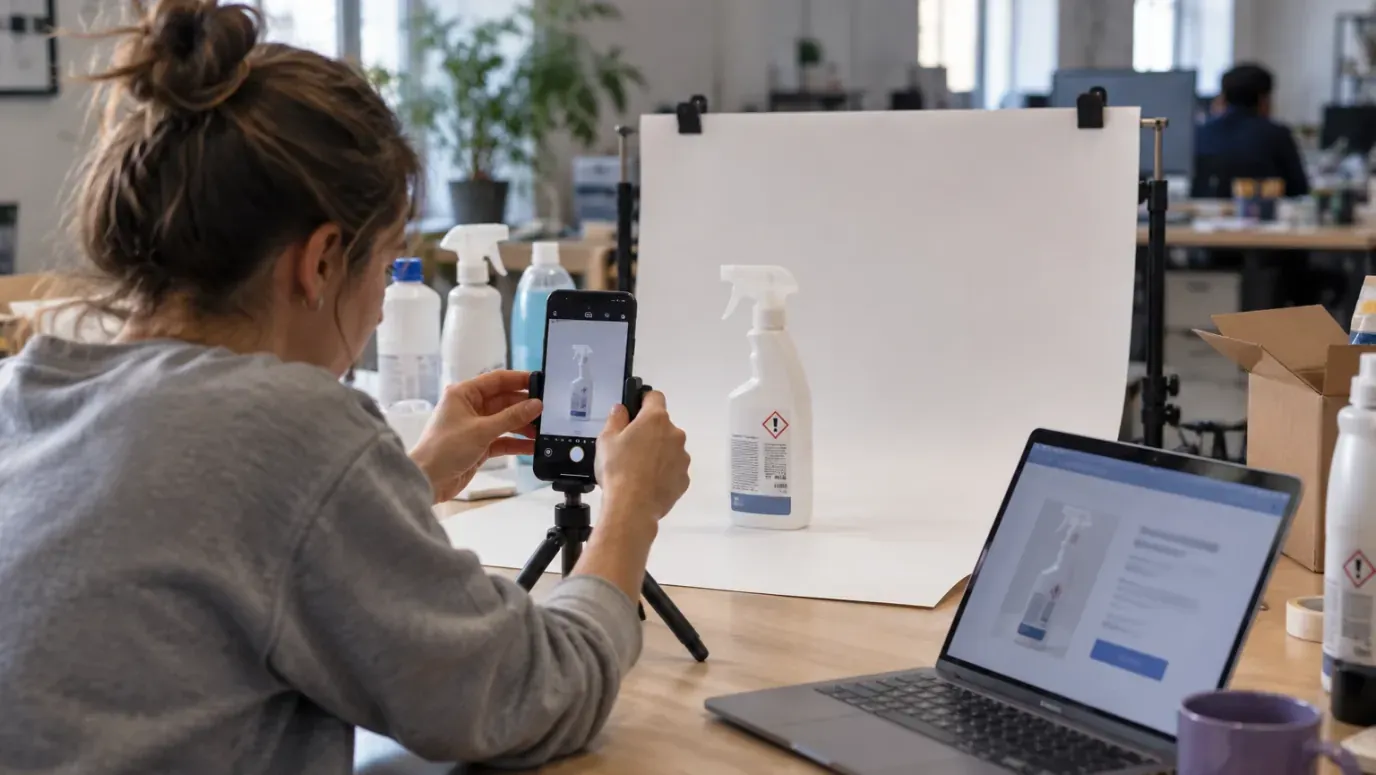
A QR code on the physical pack does nothing for an online shop listing, because the shopper cannot scan a pack they do not have yet. The label elements have to be on the product page itself. A well-structured digital label can help by giving e-commerce teams a single source for that information.
Cosmetics: no digital label
Omnibus VI amends the Cosmetics Regulation, Regulation (EC) No 1223/2009, mostly on CMR substances and the procedures for listing substances in its annexes. It does not let any mandatory cosmetic labelling move to a digital label.
The labelling change concerns online sales. A new Article 19(7) requires distance sales offers to clearly and visibly show the name and address of the responsible person, the nominal content, the precautions for use, the function of the product and the list of ingredients. It applies 12 months after entry into force. The Commission's duty to adopt a glossary of common ingredient names is removed, and the recitals encourage the Commission to give access to the internationally recognised names through digital tools such as the CosIng database.
For beauty brands, a QR code stays what it is today: an addition to a complete printed label, useful for detail and engagement. Our guide to QR codes on cosmetics packaging covers those uses.
Fertilisers: one data carrier for the label and the declaration
Fertilisers are further ahead. Regulation (EU) 2024/2516 introduced digital labels for EU fertilising products from 1 May 2027. Products sold between businesses may carry a digital label instead of a physical one, products sold without packaging may use a digital label or a leaflet, and products sold to end users in packaging keep a physical label. If they also carry a digital label, the elements marked with an asterisk in Annex III do not have to be repeated on the physical one.
Omnibus VI builds on that. The EU declaration of conformity is drawn up in electronic form and must be directly accessible in a machine-readable format, through an internet address or a data carrier. Where a digital label is used, the same data carrier must also give access to the declaration, which the recitals explain as a way to avoid several data carriers on one product. Where other Union law requires a Digital Product Passport for the product, the declaration's content and the digital labelling information are provided only in that passport. Manufacturers and importers also add a digital contact to their details on the packaging. These changes apply 30 months after entry into force.
The same pattern runs through the EU Detergents Regulation, where the digital label and the passport share one data carrier, and through the passport rules of the ESPR.
Where a QR code fits, and where it does not
CLP does not name a technology. It asks for a data carrier that widely used digital devices can process automatically. In our reading, a QR code is the practical choice, because any phone camera reads it without an app, which the "no app" rule in Article 34b requires anyway.
Where it helps:
- One code for several jobs. The fertiliser rules spell out the logic: one data carrier for the digital label, the declaration of conformity and, where required, the passport. With GS1 Digital Link, one QR code carries the product's GTIN as a web address, and a resolver can open the digital label by default while other information sits one step away.
- Updates without reprinting. Information that is legally permitted to be provided digitally only, as well as additional digital content or languages, can be updated while the printed data carrier stays the same. Where mandatory information required on the physical label changes, the physical label must still be updated within the applicable legal deadline.
- Constrained inner packaging. Once Omnibus VI applies, technically constrained inner packaging may carry only the hazard pictograms physically, while most of the remaining label elements may be provided through the digital label via a data carrier.
Where it does not:
- Pictograms and core hazard information stay printed on the pack.
- Online listings need the label elements on the page, not a code.
- Tracking. Article 34b(2) prohibits tracking, analysing or using usage information beyond what is absolutely necessary to provide the digital label. If the same QR code also leads to marketing content, keep the digital label itself free of analytics and profiling, and check how your QR platform handles that page.
What to do now
- Map your portfolio. List the products with a CLP hazard label, which of them are sold to the general public, and which have small inner packaging inside an outer box.
- Decide whether to use the digital label now. It has been available since 1 July 2026, and moving supplemental information online is the one digital-only option already in force.
- Set up a digital contact. A monitored email address or contact form, not a chatbot. It will be required on every label, and you can start using it voluntarily once Omnibus VI is in force.
- Build the digital label as a dedicated page. All label elements in one place, searchable, at most two clicks from the scan, and kept online for at least ten years.
- Remove tracking from that page. Separate any marketing content and analytics from the digital label.
- Plan one artwork change. Formatting applies at 18 months and the digital contact at 36 months; if you reprint in between, design for both.
- Fix your online listings. Distance sales offers will need the label elements for chemicals, and the main label particulars for cosmetics.
- Watch the Official Journal. Every Omnibus VI date counts from its entry into force, which depends on when the Council adopts it.
Digital Link is a GS1 solution partner, and our platform puts a standards-based GS1 Digital Link QR code on each product with a page behind it that can be updated without reprinting packaging. For CLP digital labelling, that page can be the dedicated digital label, with any other content linked separately from the same code. If you want to work out which of your label elements can move online, and from when, get in touch and our legal team will review your case.
Frequently asked questions
Is CLP digital labelling mandatory?
No. Article 34a keeps the physical label as the rule and makes the digital label optional. Omnibus VI does not make the digital label mandatory, but it adds a mandatory digital contact to every hazard label.
Can a QR code replace the hazard label?
No. Only the elements listed in section 1.6 of Annex I may be provided on the digital label only. Hazard pictograms are never among them, even on the smallest inner packaging.
When does Omnibus VI apply?
Not yet. Parliament adopted the agreed text on 22 October 2026, and the Council still has to adopt it before publication in the Official Journal. It enters into force 20 days after publication, and its digital labelling changes apply 30 months later for fertilisers and 36 months later for CLP.
What counts as a digital contact?
An up-to-date online channel, free of charge, through which the supplier can be reached without registering or installing an app, such as an email address or a web contact form. Chatbots, automatic replies, fax numbers and automated telephone lines do not count.
Can cosmetics use a digital label?
No. Omnibus VI does not allow mandatory cosmetic labelling to move online. Its labelling change for cosmetics requires online offers to show the main label particulars, from 12 months after entry into force.
Can I track scans of my digital label?
Not for marketing. Article 34b(2) prohibits tracking, analysing or using usage information beyond what is absolutely necessary to provide the digital label. Keep analytics away from the digital label page.
Do fertilisers need a QR code?
Not necessarily. A digital label is one of the permitted forms, and the declaration of conformity may be reached through an internet address or a data carrier. Where a digital label is used, its data carrier must also lead to the declaration.