

TL;DR
- Textiles, with a focus on apparel, are prioritised for the EU Digital Product Passport in the 2025–2030 ESPR working plan. The delegated act that will set the data list and the date has not been adopted yet.
- Some textile rules already apply: the fibre composition must stay on the label, and from 19 July 2026 large companies may not destroy unsold apparel, clothing accessories and footwear.
- The parts every passport shares are already fixed: a persistent unique identifier, a data carrier on the garment and open, machine-readable data. Brands can build those now.
The Digital Product Passport for textiles is the EU's planned digital record for garments, footwear and other textile products: what they are made of, where they come from, how to care for and repair them, and how to recycle them. It will be reached through a data carrier, such as a QR code on the care label or the hang tag. It comes from the Ecodesign for Sustainable Products Regulation, Regulation (EU) 2024/1781, and will apply from the date set in the delegated act for textiles.
The textile passport at a glance
| Legal basis | Regulation (EU) 2024/1781 (ESPR), through a delegated act for textiles |
| Products | Textiles, with a focus on apparel; footwear is also named among the ESPR priorities |
| Status | Prioritised in the 2025–2030 working plan; delegated act pending |
| Who will be responsible | The manufacturer, or whoever places the product on the EU market under its own name |
| How it will be reached | A data carrier on the product, its packaging or its documents, as the act specifies |
| Why textiles | Under the EU textiles strategy, textile consumption in Europe has the fourth-highest impact on the environment and climate change, after food, housing and mobility |
Where the rules stand
| Rule | What it requires | Status |
|---|---|---|
| ESPR delegated act for textiles | The Digital Product Passport and ecodesign requirements for textiles | Pending: prioritised in the 2025–2030 working plan |
| ESPR ban on destroying unsold goods | No destruction of unsold apparel, clothing accessories and footwear | Applies to large companies from 19 July 2026, and to medium-sized companies from 19 July 2030 |
| Textile Labelling Regulation (EU) No 1007/2011 | Fibre names and composition on the label | Applies now; a QR code can add information but not replace the fibre label |
For the other product groups and their dates, see the EU Digital Product Passport guide.
What data to expect
The delegated act will set the exact list. Across ESPR product groups, and from what textiles brands already publish, a textile passport is expected to draw on these families:
| Information | Examples for a garment |
|---|---|
| Identity | Product model, GTIN, batch or item, manufacturer, importer |
| Materials | Fibre composition, recycled content, substances of concern |
| Origin | Where the fibre was produced, where the garment was made |
| Durability and care | Care instructions, durability information |
| Repair | Repair instructions, spare parts such as buttons and zips |
| End of life | Disassembly, sorting and recycling instructions |
| Compliance | Declaration of conformity, certificates |
How to prepare a textile Digital Product Passport: six steps
- Assign identifiers at the right level. Use the GTIN for each product model. Plan for batch or item-level identifiers where you need traceability, resale or authentication: a GS1 Digital Link writes all three into one web address.
- Map your data and its sources. Fibre composition and care data are usually in your PLM or PIM. Origin, recycled content and substances data come from suppliers, often several tiers back, so start the requests early.
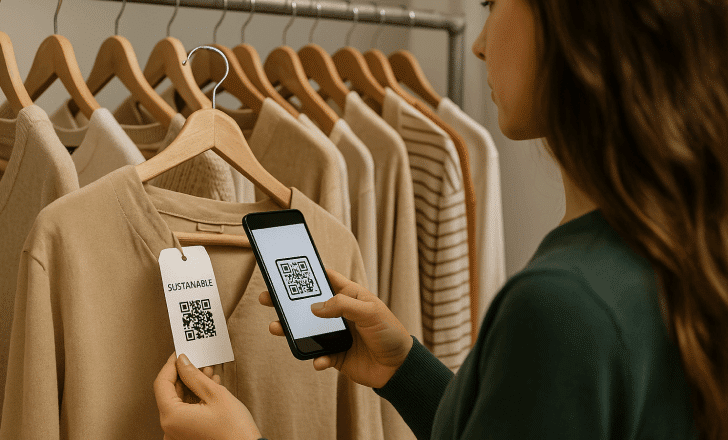
- Decide where the code goes. A hang tag is removed at home, while a printed or woven care label stays with the garment for its whole life. For a passport that has to follow the product to repair, resale and recycling, the care label is the safer place.
- Publish on open, machine-readable systems. Host the passport where it can be read by any app and updated over time, with access levels for the public, repairers and recyclers, and authorities.
- Test the code on real garments. Check the size, the quiet zone and the readability after washing, on several phones, before rolling it out.
- Follow the delegated act. When it is adopted, compare its data list, level and carrier with what you built, and adjust. The identifier, the code and the hosting won't need to change.
Pilots in the textile industry
Brands and standards bodies have tested textile passports ahead of the rules. In Sweden, the Trace4Value pilot brought together the Swedish Institute for Standards (SIS) and fashion brands including Marimekko and Kappahl, which tested product passports on selected products.
Textile passports on the Digital Link platform
Digital Link, the platform behind this site, has an apparel and textiles template for product passports. It creates a GS1 Digital Link QR code for each product from your GTINs, with variants per batch or item, and hosts the passport page in the shopper's language. Codes can be generated in bulk or from your PIM or ERP.
Create your first textile product passport
Frequently asked questions
When will textiles need a Digital Product Passport?
From the date set in the ESPR delegated act for textiles. Textiles, with a focus on apparel, are prioritised in the 2025–2030 working plan, but that act has not been adopted yet.
What will a textile Digital Product Passport contain?
The delegated act will set the list. It is expected to cover identity, fibre composition and recycled content, substances of concern, origin, durability and care, repair, and end-of-life information.
Can a QR code replace the textile fibre label?
No. Under the Textile Labelling Regulation (EU) No 1007/2011, the fibre composition must stay on the label. A QR code can add detail, such as origin, care and recycling information.
Where should the QR code go on a garment?
The delegated act will specify the carrier and its position. A printed or woven care label stays with the garment for its whole life, so it suits a passport that has to follow the product to repair, resale and recycling. A hang tag is usually removed after purchase.
Can brands still destroy unsold clothing in the EU?
Not large companies, from 19 July 2026: the ESPR bans them from destroying unsold apparel, clothing accessories and footwear. Medium-sized companies follow from 19 July 2030.